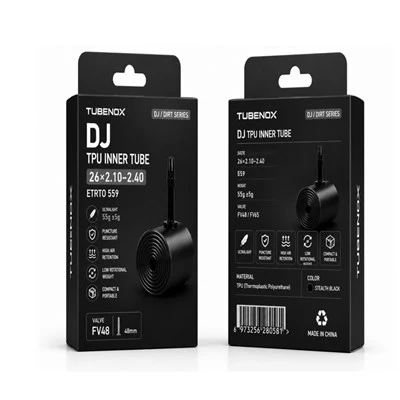
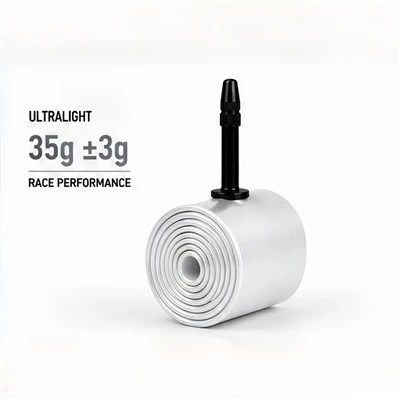
If you've ever stood in a bike shop staring at a wall of inner tubes and wondered which one is actually yours, you're not alone. Road bike inner tubes come in a confusing number of sizes, valve types, materials, and weights - and the packaging usually doesn't help.
This guide cuts through it. By the end you'll know exactly which tube fits your bike, whether TPU is worth the upgrade, how long a valve you need, and what weight difference actually means on the road.
1. What size road bike inner tube do I need?
Road bikes use one of two wheel sizes:
700c (ETRTO 622). This is the standard for nearly all modern road bikes, gravel bikes, and most fitness bikes. If your bike says "700×25c" on the tire, you need a 700c tube.
650c (ETRTO 571). Used on small-frame road bikes (usually for riders under ~5'6"/165 cm), junior race bikes, and some triathlon bikes. If your tire says "650×25c," this is your size.
The second number on the tire - the width - tells you which tube range to pick. Tubes are made to fit a range of widths, not one exact size:
|
Tire width |
Tube size range |
Common on |
|
18–23c |
700×18–23c |
Narrow race tires, time trial |
|
23–28c |
700×18–28c |
Most road bikes sold today |
|
28–32c |
700×23–32c |
All-road, endurance, wider tires |
|
32–50c |
700×32–50c |
Gravel-adjacent road bikes |
Rule of thumb: pick a tube whose width range includes your tire width. A tube that's too narrow will stretch and feel fragile; one that's too wide will bunch up inside the tire and fold.
2. TPU vs butyl: what's actually the difference?
For decades, every inner tube was made of butyl rubber. It's cheap, it works, and it's heavy. TPU (thermoplastic polyurethane) tubes started appearing around 2015 as a lighter alternative. Here's how they actually compare:
|
Butyl tube |
TPU tube |
|
|
Weight (700×25c) |
~105 g |
25–36 g |
|
Folded size |
Brick in your saddle bag |
Golf-ball sized |
|
Air retention |
Seeps through rubber; top up weekly |
Holds pressure for weeks |
|
Puncture behavior |
Blows out suddenly |
Pinsholes and leaks slowly |
|
Patching |
Easy with standard patches |
Needs TPU-specific patches |
|
Cost per tube |
\(5–\)10 |
\(15–\)30 |
|
Feel on the road |
Dull, draggy |
Snappier acceleration |
The honest trade-off: TPU tubes are lighter and pack smaller, but they're thinner and cost more. They're not bulletproof - you still get flats. The difference is that when a TPU tube does puncture, it tends to leak slowly rather than blow out, so you usually roll home instead of standing on the shoulder.
For most riders, the upgrade is worth it if you care about weight at all. If you're riding a beater commuter and never think about grams, butyl is fine.
3. Presta valves: which length do you need?
Nearly all road bikes use Presta valves (the skinny ones with a tiny nut on top). The confusing part is the length.
Presta valves come in 45 mm, 65 mm, and 85 mm. You need one that sticks out far enough through your rim to actually attach a pump.
|
Rim depth |
Valve length you need |
|
Up to 30 mm (standard alloy) |
45 mm |
|
30–50 mm |
65 mm |
|
50–80 mm (deep carbon aero) |
85 mm |
Rule of thumb: measure how deep your rim is, then add about 15 mm. If the valve doesn't stick out, you'll struggle to get the pump head on.
You can buy valve extenders, but they add another point of failure. Buy the right length from the start.
4. How much does inner tube weight actually matter?
This is the question everyone argues about. Here's the short version:
A butyl tube weighs ~105 g. A TPU tube weighs 25–36 g. That's 70–80 g saved per wheel, or 140–160 g off the whole bike.
Because the tube is on the outside of the wheel hub - it's rotating mass, not static weight - it matters more than dropping 160 g off your handlebars or seatpost. The exact number depends on who you ask (and how much money they've spent on carbon parts), but most riders feel the difference on acceleration and climbs.
Where it doesn't matter: on a flat TT bike, or if you're riding in a group and never accelerating.
Bottom line: if you're already looking at carbon wheelsets, a lighter tube is the cheapest weight savings left on the bike.
5. How to patch a TPU tube
TPU tubes patch differently than butyl. Standard rubber patches don't stick well to TPU. Here's what works:
Find the hole. Inflate the tube and listen, or dip it in water and look for bubbles.
Roughen the area around the hole with light sandpaper or the scraper on your patch kit.
Use a TPU-specific patch. Most TPU tube brands sell their own patches, or you can use a pre-glued TPUpatch.
Hold pressure for 30 seconds. Don't let go early.
Wait 5 minutes before reinflating.
Small pinholes patch reliably. If the cut is longer than 1 cm, replace the tube.
6. When to replace a tube vs patch it
Patch it if:
The hole is smaller than 5 mm
It's near the center of the tube, not near the valve stem
You have a TPU patch kit
Replace it if:
The cut is longer than 1 cm
The hole is right at the valve base (that area can't be patched reliably)
The tube is more than a couple of years old and the wall is getting thin
You're on a long ride and patching isn't worth the time
7. The quick buying checklist
Before you order a road bike inner tube, answer these five questions:
What's your wheel size?
700c (622) or 650c (571)?
What's your tire width?
Check the sidewall - e.g., 700×28c means you need a tube that covers 28c.
How deep is your rim?
Measure it, then pick a valve length that sticks out 15 mm past it.
Butyl or TPU?
If you care about weight and pack size, TPU. If you want cheap and forgiving, butyl.
One tube or a spare?
Most riders run a butyl or mid-weight TPU in the wheel and carry a lightweight TPU as the spare.
Common questions
Can I use a 25c tube on a 28c tire?
If the tube's range covers 28c, yes. A tube labeled "700×18–28c" fits anything from 18c to 28c. Don't use a tube labeled "18–23c" on a 28c tire - it'll stretch too thin.
How long do TPU tubes last?
With proper installation, 2–5 years. The wall is thin, so they wear out eventually. If a tube starts holding pressure poorly between rides, it's time to replace it.
Do TPU tubes work with CO₂ inflators?
Yes. Just don't freeze the tube with a direct blast - start low and work up to pressure.
Can I use a TPU tube on indoor trainers?
Yes, but it's overkill. Use a cheaper butyl or mid-weight TPU on the trainer. Save the 25 g tubes for outside.
Ready to pick a tube?
If you've read this far, you know your size, your valve length, and whether you want butyl or TPU. We make TPU tubes in the full 700c and 650c range, in colors, with private-label packaging. Send us your spec and we'll point you to the right SKU.
Email: jake@tubenox.com · WhatsApp: +86-136-1308-5191.