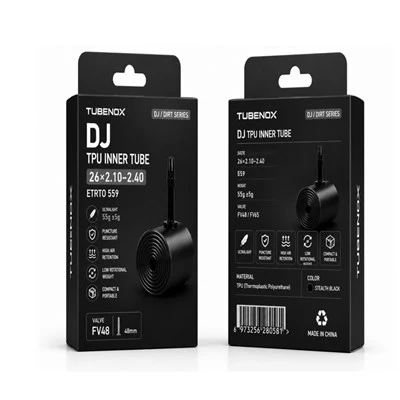
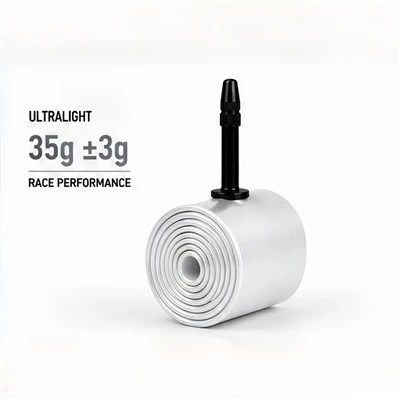
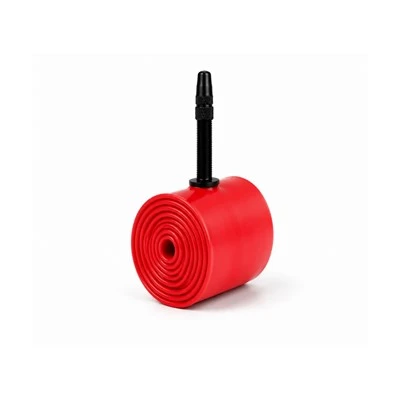
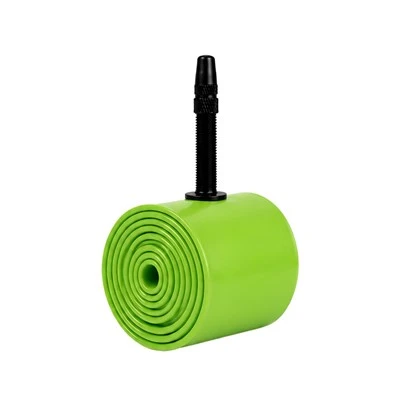
Five years ago, if you wanted a sub-50g road tube, your only real option was a latex tube that went flat overnight. Today, TPU (thermoplastic polyurethane) tubes from brands like Schwalbe Aerothan, Tubolito and a growing list of OEM factories have rewritten the weight-versus-convenience trade-off.
But there is still a lot of confusion out there. Do TPU tubes really roll faster? Can you patch one on the roadside? Do they actually leak in winter? And if you are a brand or distributor looking to stock or private-label them, what separates a good TPU tube from a landfill-bound one?
This guide answers those questions the way a mechanic and a buyer would ask them.
What Is a TPU Inner Tube, Anyway?
A TPU inner tube is a tube extruded or laminated from thermoplastic polyurethane film instead of vulcanized butyl rubber. Think of it as the cycle-industry cousin of the ultralight inflatable camping pad.
A standard 700×25c butyl tube weighs around 100–120g. A TPU tube in the same size lands between 30g and 60g - roughly a 60–75% saving. Rolled up, it is the size of a candy bar, which is why it has become the default spare for gravel bikepackers, road racers and anyone who hates carrying a brick in their jersey pocket.
The material itself is not new. What is new is the film gauge and the valve-bonding process, which is why cheap no-name TPU tubes and a 4× more expensive name-brand product can feel like entirely different objects.
TPU vs Butyl: Side-by-Side
| Criteria | Butyl | TPU |
|---|---|---|
| Weight (700×25c) | 100–120g | 30–60g |
| Rolled size | Bulky | Pocket-sized |
| Rolling resistance | Baseline | Low, close to latex |
| Air retention (per 24h) | Excellent (<1%) | Moderate (1–4%, drops in cold) |
| Roadside repair | Easy, any patch kit | Possible, but needs TPU-specific glue |
| Price (retail, US) | $5–$10 | $15–$40 |
| Best for | Everyday commuter, e-bike, spare | Ultralight spare, gravel, road |
The Real Pros and Cons
Weight savings you can actually feel
Switching two butyl spares for two TPU spares on a road bike saves roughly 140–160g on the bike - more than a carbon cage upgrade. On a gravel or bikepacking rig, where riders carry two or even three spares, the saving hits 250g or more. That is the single most cited reason customers buy TPU, and it holds up in real life.
Puncture repair - the biggest objection
Here is the honest part. Standard rubber cement does not bond to TPU. If a rider tries to patch a TPU tube with a classic butyl patch kit, the patch will peel off within a day.
You need:
A TPU-specific adhesive (cyanoacrylate or UV-cure type), or
A manufacturer patch kit with pre-treated patches (e.g. Tubolito Tubo Patch, Schwalbe Aerothan patches, Park Tool GP-2C), and
A clean, dry work area. Roadside, the success rate drops sharply.
The practical workaround the pros use: carry a TPU spare tube, not a patch kit, for the roadside. Repair the punctured one at home on a workstand. A well-made TPU tube can take 3–5 patches over its life, so it is not disposable - but it is not a butyl tube either.
Cold-weather air retention
This is the complaint you see most in winter forum threads. TPU film stiffens as temperature drops, which slows the valve seal and the micro-porosity behavior. A tube that loses 2 psi a day at 20°C might lose 5–8 psi at 0°C.
Does this make TPU unrideable in winter? No. Does it mean you should pump up before every ride in January? Yes. Brands that source TPU tubes should ask their supplier about the low-temp film grade - not all TPU compounds behave the same below 5°C.
Rolling resistance
Independent rolling-resistance tests (including BikeRadar and an ongoing Rouleur data set) put TPU within a few percent of latex, and clearly ahead of butyl. On a long climb, that gain is real but small. Do not buy a TPU tube expecting a 30-second-a-breakthrough; buy it because it is light and small.
TPU vs Tubeless: Do You Even Need a Tube?
Tubeless is still the fastest setup for MTB and for riders who ride thorny terrain and want sealant to plug 3–4mm cuts automatically.
Where TPU wins:
- You already have clincher wheels that are not tubeless-ready.
- You want a spare that works with any rim on a group ride.
- Sealant maintenance is a chore you would rather skip.
- You race, and a flat at the feed zone needs a 3-minute fix.
Most serious gravel riders now run tubeless in the front and carry a TPU tube as a backup. That hybrid is probably the sweet spot for 2026.
Size and Valve Quick-Reference
TPU tubes are not universal. Buy by tire size, not by "700c".
Road (700c):
18/23c, 25c, 28c, 30/32c are the common skus.
Presta valve, lengths 42mm / 60mm / 80mm for deep-section rims.
Gravel:
35c, 40c, 45c, 47c.
60mm Presta is the default; 80mm for carbon gravel rims.
MTB:
26×1.9/2.35, 27.5×2.1/2.6, 29×2.1/2.6.
Schrader (AV) and Presta both exist; check the rim.
BMX / kids / folders:
20×1.75–2.4 (BMX), 16″/20″ kids, 406/451 folders.
40mm valves are standard here.
What Brands and Distributors Should Check Before Sourcing
If you are reading this as a buyer - sourcing private-label TPU tubes for your bike shop, brand or Amazon listing - the spec sheet tells you half the story. The other half is on the factory floor.
1. Film gauge and weight tolerance
Cheap TPU tubes are over-gauge on purpose: a 50g tube that weighs 68g on your scale is not a "50g tube". Ask for a sample batch and weigh 10 units. Real weight tolerance should be within ±3g of the printed spec.
2. The valve is the failure point
The valve base where the stem bonds to the film is where 80% of TPU tube failures happen. Two questions:
Is the valve core removable? (Non-removable cores cannot be serviced or replaced.)
Is the stem brass, plated steel or plastic? Brass runs 8–12g and survives; plastic stems snap in cold weather.
3. Cold-weather compound
Ask the supplier explicitly: "What is the air-loss rate at 0°C after 24 hours?" A factory that does not have that number is guessing. Good TPU compounds now run 3–4% at freezing, down from 8–10% in 2022 vintage film.
4. MOQ, artwork and packaging
Typical private-label terms in 2026:
Blank tubes: 500 pcs MOQ.
Printed logo: 1,000–3,000 pcs.
Custom hang card / box: 1,000 pcs.
Color film (blue, orange, transparent): 1,000 pcs.
Beware of suppliers that quote 1000 pcs for full custom packaging - that usually means they are printing on a generic box and calling it custom.
5. Quality control paperwork
For the EU and UK markets, expect to support REACH and (if marketed as a component) EN safety documentation. For the US, CPSC general compliance. A real TPU factory can produce batch test reports; a trading company usually cannot.
6. Patch kit bundled?
The single highest-return upsell you can ship with a TPU tube is a TPU-specific patch kit. Retailers who bundle the two see fewer "does not work" returns, because 90% of negative reviews on TPU tubes come from riders who tried to patch them with butyl glue.
Three Myths Worth Killing
Myth 1: TPU tubes are disposable. Good ones are not. A TPU tube with three patches is still lighter than a new butyl tube. Treat it like a repairable component.
Myth 2: They pinch flat easily. The film is thin, but pinch flats come from low pressure, not film material. Run the recommended pressure and pinch flats are no more common than with butyl.
Myth 3: All TPU tubes are the same. They are not. The gap between a 32g OEM tube with a brass valve and a 32g tube with a plastic valve is the difference between a two-season product and a one-season product. Buy the sample batch before you buy the container.
FAQ
Are TPU inner tubes worth the money?
If you ride road, gravel or bikepacking and care about weight and pack size, yes. If you commute in rain, potholes and salty roads, a $6 butyl tube is still the rational choice.
Can you use a regular patch kit on a TPU tube?
No. Standard butyl cement will not bond. Use a TPU-specific adhesive or the manufacturer's patch kit, and do the repair off the bike at home.
How long do TPU tubes last?
Typically 2–4 seasons on a road bike, depending on crash and patch count. UV exposure is the enemy - store spares in a bag, not in direct sun.
Do TPU tubes work on e-bikes?
Most do, but verify the factory's e-bike rating. Heavier riders and faster urban average speeds run higher heat load, and not all film gauges are spec'd for it.
What is the cheapest reliable way to stock TPU tubes as a reseller?
Start with a mixed-size sample order, weigh 10 units, and bundle a patch kit with every retail unit. Private-label runs become worthwhile once you move 500+ units per quarter.
Sourcing TPU Tubes for Your Brand
At TUBENOX we manufacture TPU inner tubes for road, gravel, MTB, BMX, folding and e-bike platforms from our Shenzhen facility. We ship blank samples within 48 hours, support private-label artwork from 1,000 pcs, and supply a TPU-specific patch kit as a matched SKU.
If you are evaluating OEM factories, ask us for the sample batch and the cold-temperature air-retention sheet - the two numbers most suppliers will not volunteer.