Mountain bike tyre pressures have been falling for years. A decade ago, 30–35 psi in an XC tyre was normal. In 2026, XC riders are running 22–28 psi, downcountry bikes are pushing into the low 20s, and at the top of the sport it gets extreme - at the 2026 Val di Sole XCO World Championships, race winner Puck Pieterse's Canyon ran about 16–17.5 psi.
Low pressure is faster and grippier. It's also where the problems start. Squeeze a 2.25" tyre down to 16 psi over a rock garden and the rim can smash the sidewall into the ground - the classic "snakebite" pinch flat. And that's exactly where a very light, very packable tube suddenly matters again.
Downcountry made low pressure mainstream
The downcountry category - the lightweight space between XC and trail - became the story of 2025–2026. It pairs fast, XC-style tyres with slightly more suspension and much lower pressure for traction. Riders run 22–28 psi on 2.3–2.4" tyres, and pinch-flat protection is the main worry.
This is the paradox of modern MTB: the lower you go for grip, the more exposed your tyre is to a pinch flat. Tubeless handles this better than a tube - no inner tube means no tube to pinch. But tubeless is not free.
The real cost of tubeless on a mountain bike
Tubeless is the right answer for most serious mountain bikers - the MTB-News 2026 comparison concludes as much, and it's what nearly every World Cup XC bike runs on race day. But the system has costs that rarely get counted in the marketing:
- Sealant is a recurring chore. It dries out every few months, needs topping up, and turns tyre changes into a mess.
- Mounting is harder, especially on tighter bead or hookless rims. Trailside fixes are genuinely awkward.
- It only works on tubeless-ready rims. Your wheels decide the argument for you.
- A puncture that won't seal means a tube anyway. When a sidewall tears or a thorn defies the sealant, tubeless leaves you carrying a tube as backup - or stranded.
That last point is why even the most committed tubeless riders pack a spare tube. And in 2026, that spare tube is increasingly made of TPU.
Why TPU inner tubes make sense for mountain biking
TPU (thermoplastic polyurethane) tubes took over road and gravel first. For mountain biking, the appeal is different but just as strong:
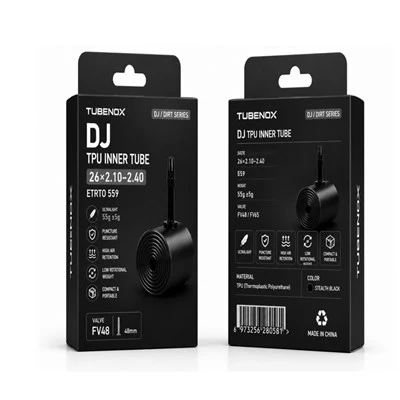
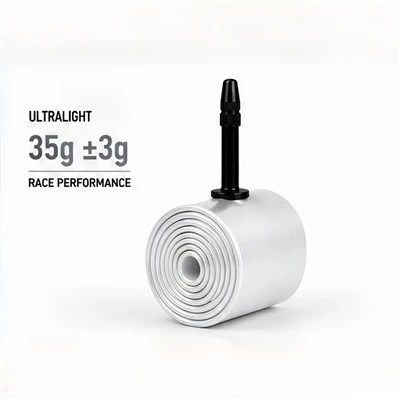
- Weight. The lightest MTB TPU tubes are around 42g for tyres up to 2.5". That's roughly 80% lighter than a comparable butyl tube - and it means the TPU tube often weighs less than the sealant you'd put in a tubeless setup.
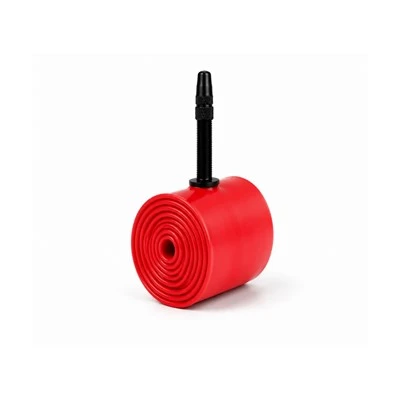
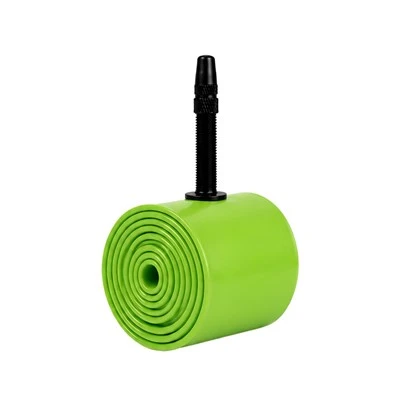
- Pack size. A TPU tube rolls down to about the size of a golf ball. It fits in a hip pack or jersey pocket next to the CO₂ canister, which is where a spare should live.
- Strength. TPU has higher tensile strength than butyl at the same wall thickness, which matters on a rocky trail.
- Speed. Independent comparisons credit TPU with roughly 5 watts saved versus butyl, with air retention on par.
The honest trade-offs: TPU costs about 3× butyl, and it needs TPU-specific patches - rubber patches won't bond to it. Cheap TPU is inconsistent, so tested brands matter. But as a spare, the price argument collapses: you're carrying it once, and it's lighter than everything else you'd stuff in a pack.
MTB inner tube comparison, head to head
|
Tubeless |
Butyl tube |
TPU tube |
|
|
Weight (system) |
Heavier once you add sealant + rim tape |
Heavy |
Lightest (~42g, 80% lighter than butyl) |
|
Pinch-flat protection |
Excellent (no tube to pinch) |
Good |
Good, but thin walls can pinch |
|
Small puncture |
Sealant self-seals while riding |
Needs a patch/spare |
Needs a patch/spare |
|
Installation |
Tubeless rim + sealant, harder mounting |
Drop in any rim |
Drop in any rim, like a normal tube |
|
Roadside repair |
Messy, hard |
Simple patch |
TPU-specific patch or swap |
|
Maintenance |
Sealant top-ups every few months |
None |
None |
|
Packability (spare) |
N/A |
Bulky |
Tiny - rolls to golf-ball size |
|
Cost |
Higher upfront |
Lowest |
~3× butyl |
So what should you actually ride?
Racing and fast XC: tubeless, no question - it's the fastest, most puncture-resistant race setup. Carry a TPU spare for the puncture that won't seal.
Downcountry / low-pressure trail: tubeless for traction, TPU as the backup you'll actually want at 22 psi.
Casual and budget riders, or non-tubeless rims: a good TPU tube is now the best all-round inner tube - lighter than butyl, faster, and it rolls up small.
Anyone who hates sealant: TPU is the clean, drop-in-any-rim answer.
Where MTB TPU tubes are going
The category is maturing fast. Wall thickness is dropping on race tubes, valve designs are getting replaceable cores, and TPU patch kits are improving - chipping away at the repairability gap that held it back. Smart tubes with embedded pressure sensors are appearing on the road side and will find their way to gravel and MTB. The market signal is clear: the bicycle tube market flagged thermoplastic polyurethane as the biggest technology shift of 2025, and lightweight TPU is where the growth is concentrated.
What this means if you're bringing a product to market
We build TPU inner tubes on an OEM/ODM basis, and the mountain bike side is one of the fastest-moving parts of the business. The briefs we see have shifted from standard butyl sizes to specific TPU requests: a target wall thickness, a valve length that works with deep or thick rims, an XC weight target around 40g, and private-label packaging for brands that want their own tube in the box. The 27.5" and 29" XC/downcountry widths are the sweet spot; the 24" kid's and e-MTB widths are growing.
If your brand is deciding whether to carry TPU for MTB in 2026, the weight and pack-size story writes itself for the spare-tube role - and that's where the demand is: a tube so light it disappears in a pack, as a complement to the tubeless system most serious riders already run.
Low-pressure MTB made the spare tube matter again, and TPU is the best spare ever made - light enough to forget, small enough to always carry. For riders it's the reliable safety net tubeless can't be. For brands, it's the fastest-growing slot in the inner-tube market right now.