If you bought a road bike in 2026, it almost certainly came on tyres you wouldn't have found on a race bike five years ago. 28mm is now the floor. 30mm and 32mm are mainstream, "all-road" bikes ship on 40mm rubber as standard, and a few brands are talking about 50mm road tyres - a conversation that used to belong exclusively to gravel.
The UCI even rewrote its equipment rules for 2026, capping rim depth at 65mm and mandating a minimum 400mm handlebar width. The message is blunt: wide is faster, and the industry has stopped pretending otherwise.
But wide tyres reopened a question that refuses to die. At the low pressures wide tyres are designed to run, what is the best way to hold air? For the last decade the answer was tubeless. In 2026, the answer is quietly becoming a very thin TPU tube.
What the 2026 tyre change actually means
The shift didn't come from marketing. Teams measured it. Wider tyres run lower pressure, which lowers rolling resistance, spreads the contact patch, and smooths out road buzz without giving up speed. Once the WorldTour moved to disc brakes, the mechanical limit on tyre width disappeared, and the width race started.
The progression was fast: from 25mm as the standard for everything, to 26, 28, 30, 32 - and now 40mm being "normal" on all-road bikes. The knock-on effect is on the wheels. Wide rims (25mm+ internal width) are now standard, and hookless rims are spreading because they're lighter and cheaper to make.
For anyone buying a tyre or tube, the practical takeaway is simple: whatever you run, it now has to work at 55–75 psi, on a wider rim, on a wider tyre.
Tubeless made sense - until it didn't
Tubeless is genuinely good. No tube means no pinch flats, sealant plugs small punctures while you keep riding, and rolling resistance is lower than almost any tube setup. On paper it's the "pro" answer, and it is what most WorldTour teams run on race day.
The problem is what tubeless costs in the real world:
It only works on tubeless-ready rims. If your wheels aren't hookless or tubeless-compatible, the argument dies on arrival.
Sealant is a recurring chore. It dries out, needs topping up every few months, and makes a mess when you change tyres.
Mounting is harder, especially on hookless rims. Roadside fixes are genuinely awkward.
It weighs more than people think once you count sealant and rim tape - and the system is more fragile at the bead than a conventional setup.
None of this is new. What is new is that TPU tubes have closed most of the gap on the only thing tubeless used to win outright: weight and rolling resistance - without any of the sealant or rim dependency.

TPU inner tubes: the lightweight answer
TPU (thermoplastic polyurethane) tubes went from novelty to mainstream in 2025–2026 faster than almost any component in recent memory.
The numbers explain why:
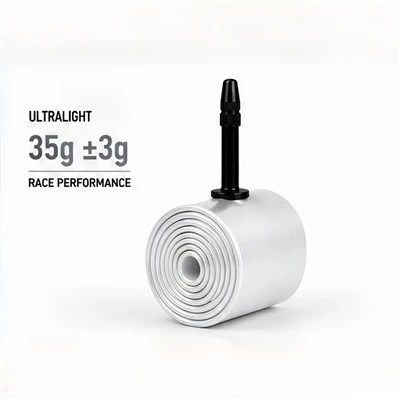
Weight. A TPU road tube weighs roughly 25–45g - about 60–75% lighter than butyl, and about half of latex. Tubolito's Tubo Road comes in around 38g, saving about 70g of rotating mass per wheel versus a standard butyl tube.
Rolling resistance. Independent tests put premium TPU tubes at or near latex-level rolling resistance. In one published comparison, the Schwalbe Aerothan measured about 10.4W per tyre - roughly 1.4W lower than a standard butyl tube - with the Pirelli SmarTube EVO just behind.
Pack size. A TPU tube rolls down to roughly the size of a golf ball. You can carry two spares and a patch kit in a jersey pocket without noticing.
Air retention. TPU holds air for weeks, much better than latex, and close enough to butyl for most riders.
Puncture resistance. The thin walls are the trade-off, but materials like Vittoria's 0.3mm Ultra Light Speed are explicitly approved for road use, and several brands claim double the puncture resistance of butyl in independent testing.
That combination - near-latex speed with butyl reliability and a fraction of the weight - is why TPU is now the default recommendation for racing and performance road riders who don't want to deal with sealant.
TPU vs tubeless, head to head
|
Tubeless |
TPU inner tube |
|
|
Weight (system) |
Heavier once you add sealant + rim tape |
Lightest - 25–45g per tube |
|
Rolling resistance |
Very low (best on race setups) |
Near-latex, close behind |
|
Pinch-flat protection |
Excellent (no tube to pinch) |
Good, but thin walls can pinch |
|
Small puncture |
Sealant self-seals while riding |
Needs a patch or spare |
|
Installation |
Needs tubeless rim + sealant, harder mounting |
Drop in any rim, like a normal tube |
|
Roadside repair |
Messy, hard |
Simple patch, or swap the tube |
|
Maintenance |
Sealant top-ups every few months |
None |
|
Cost |
Higher upfront (rim + sealant) |
$10–40 retail per tube |
The honest verdict: if you have tubeless-ready rims, ride a lot, and hate stopping, tubeless is still excellent. If you want the lightest rotating mass, run any rim, change tyres often, or race - TPU is now the better answer, and it's a lot less hassle.
So which should you run?
Racing and fast group rides: TPU. The weight saving is real and you're changing tyres anyway.
Commuters and all-weather riders: butyl or TPU depending on budget; puncture protection matters more than weight.
Riders already invested in hookless tubeless wheels: staying tubeless is reasonable - the system is already bought and paid for.
Any rim, any tyre, no sealant ever: TPU.
What this means if you're bringing a bike to market
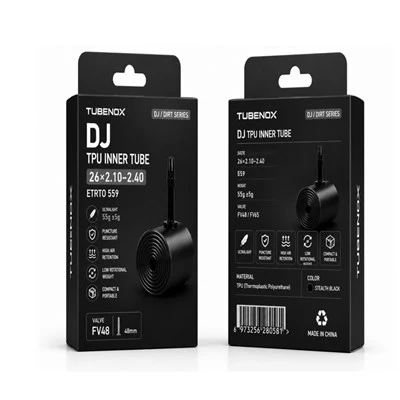
We build TPU inner tubes on an OEM/ODM basis, and the shift has been unmistakable. Two years ago almost every inquiry was butyl, in two or three standard sizes. Now a large share of the briefs we get are TPU, and they're specific: a target wall thickness, a custom valve length for deep-section rims, a disc-only rating, a brand logo and box design for private-label retail. The 28–32mm band is the sweet spot, and 40mm gravel/road widths are the fastest-growing ask.
If you're a brand deciding whether to carry TPU for 2026, the demand data points one way: the market research on bicycle tubes flags the move to thermoplastic polyurethane as the biggest technology shift of 2025, with lightweight TPU tubes under 40g gaining share in road and racing. Butyl still dominates overall volume, and it will for years - but in the performance road segment, TPU is where the growth is.
Wide tyres changed what a road bike needs to hold air at low pressure. For riders, TPU is now the lightest, least-fussy way to get there. For brands, it's the fastest-growing part of the inner-tube market - and the window to differentiate on spec, quality and private label is open right now.