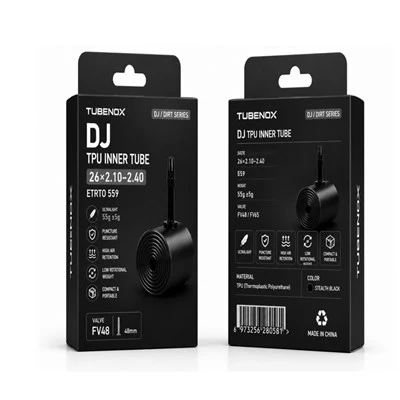
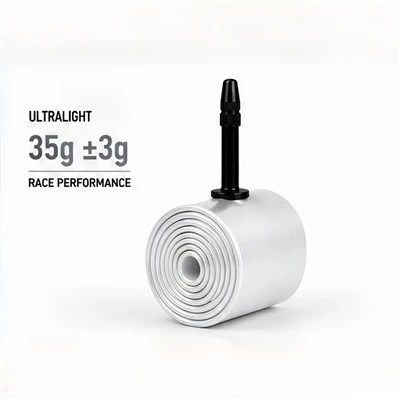
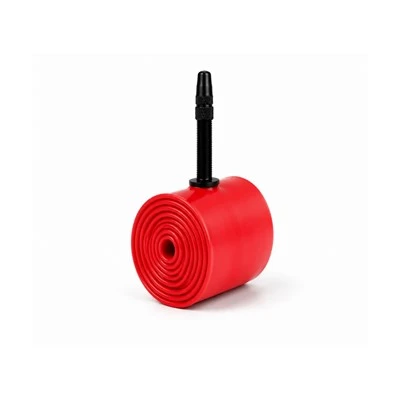
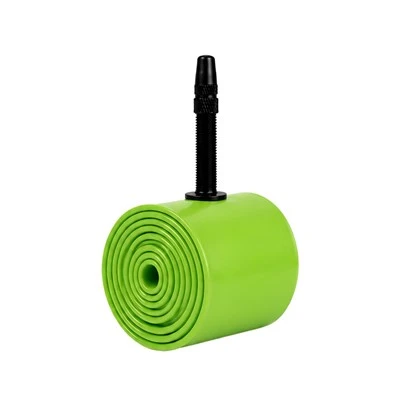
For cycling brands and distributors in North America and Europe, sourcing a TPU bicycle inner tube in 2026 is no longer just about picking the lightest tube on the spec sheet. Valve construction, exact tire-fit ranges, wall-thickness grades, private-label MOQ and after-sales support have all become points of comparison between suppliers.
This guide walks through what established brands are doing, where product ranges are heading, and what OEM buyers should put on their checklist before placing a private-label order.
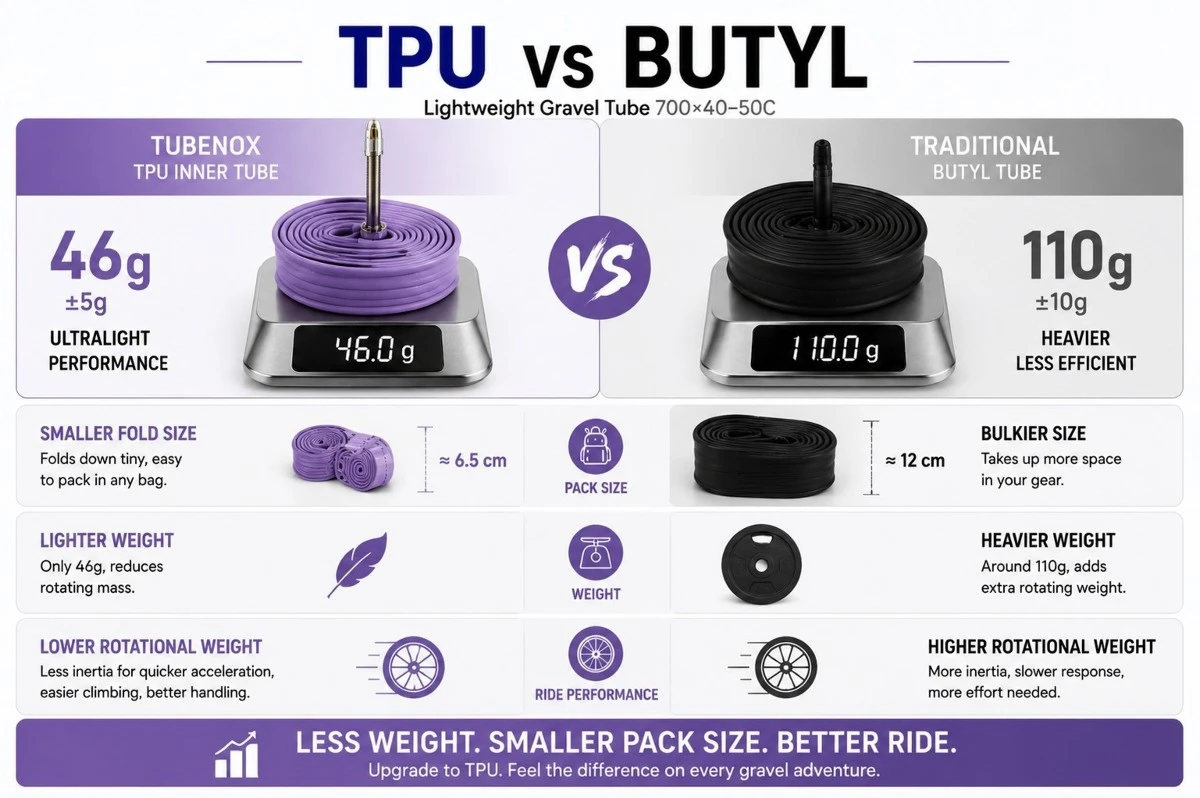
TPU vs Butyl at a Glance
Before diving into trends, it helps to be clear on what TPU actually changes for the rider - and where it does not.
|
TPU Inner Tube |
Butyl Inner Tube |
|
|
Typical weight (700×25) |
40–60 g |
180–250 g |
|
Folded pack size |
Palm-sized, fits in a jersey pocket |
Bulky |
|
Air retention |
Needs topping up every 1–2 weeks |
Good for weeks |
|
Puncture resistance |
Lower; thinner film |
Better |
|
Repairability |
Glueless patches / sealant only |
Conventional patches |
|
Retail price range |
$25–60+ |
$5–15 |
|
Best role |
Spare / race / weight-conscious |
Daily trainer |
TPU is not a drop-in replacement for every butyl tube. It is a specific product: light, compact, and positioned around weight-sensitive riders. That positioning matters when a distributor builds an assortment.
Valve Design Moves Into Focus
One of the clearest shifts in 2025–2026 is valve construction.
Schwalbe's current Aerothan tubes moved to an aluminum valve stem with an external thread, replacing the earlier plastic stem. Hutchinson's TPU range lists an aluminum Presta valve with a bonded TPU base. The direction is consistent: buyers now expect a valve that feels like a machined part, not a glued-on afterthought.
For private-label projects, "metal valve" on a spec sheet is not specific enough. Ask the manufacturer:
- How is the valve base bonded to the tube? Ultrasonic weld, molded TPU base, or adhesive?
- Is the valve core removable? A removable core lets you inject sealant and swap a damaged core without discarding the tube. A removable core and a fully removable valve are two different features.
- Is the stem fully threaded, or only threaded near the top? Fully threaded stems lock tighter on deep-section rims and accept extenders.
- What valve lengths are actually in stock? Presta 45 / 65 / 85 mm covers most road and gravel rims; Schrader 45 mm is still required for many e-bike and downhill rims.
- Is a black-anodized finish available? It is a small detail but a common brand request.
A simple rim-depth guide for your listings:
|
Rim depth |
Suggested Presta valve |
|
Under 30 mm |
45 mm |
|
30–50 mm |
65 mm |
|
Over 50 mm / aero |
85 mm |
If you only stock one valve length, you are turning away riders with carbon aero wheels.
Road: Fit Details Beat Headline Weight
Low weight still sells road TPU inner tubes, but the SKU that actually ships is the one that fits.
Tubolito's Tubo-Road covers 700×23–35 mm. Hutchinson lists a 700×25–35 option in several valve lengths. The pattern: road ranges now publish a narrow tire-width band per SKU, not a vague "700c" claim.
When you build a wholesale road range, each SKU should carry three numbers on the listing: tire width range, bead seat diameter (622 for 700c, 571 for 650b), and valve length. Install notes - recommended tire pressure and rim width - reduce returns.
Be careful with overlap. A tube that spans 28–47 mm is really a gravel / all-road tube. Marketing it as "road" confuses road riders and wastes the gravel positioning.
Gravel: Durability Joins Pack Size
Gravel riders already understand the folded-pack benefit. The newer trend is around durability and ownership support.
Tubolito's X-Tubo-Gravel is sold with a one-year puncture replacement offer. That is one brand's policy, but it shows where competition is moving: warranty, replacement logic and spare-part support are becoming sales tools, not just after-sales details.
For OEM buyers, pick the role before the spec. An emergency spare (ultra-light, tiny pack, lowest cost) and a daily gravel training tube (slightly thicker film, longer life) should be two SKUs with different wall thickness - not one tube marketed two ways.
Puncture-resistance claims should always reference the exact model and test method, not the whole TPU family.
MTB: Split Spare Tubes From Workhorse Tubes
Mountain bike TPU tubes fall into two use cases that do not overlap much.
Tubolito positions its S-Tubo-MTB as a lightweight spare (race-day backup in the pocket), while the standard Tubo-MTB balances weight and robustness for regular use. Distributors can copy this structure: list a "spare" and a "daily" line, each with its own size range and wall thickness.
When listing MTB sizes, print the ETRTO number next to the inch range (for example 29×2.25–2.50 / 622). Brake type is rarely an issue for TPU tubes, but wheel diameter and tire width are. A compact spare-tube kit with glueless patches also sells well in bike shops - provided the patch material is actually compatible with TPU film.
BMX: Rim Diameter Has to Be Printed
"20-inch tube" is not a complete SKU.
BMX and dirt jump use two rim standards - 406 and 451 - and they are not interchangeable. A 20×1-1/8 (451) tube does not fit a 20×1.75 (406) wheel. List both numbers on the spec sheet.
Fractional and decimal inch names (1-3/8 vs 1.375, 1-1/8 vs 1.125) look interchangeable but confuse shoppers. Standardize one format on your listings.
Dirt jump 26-inch tubes belong under a "BMX / Dirt Jump" category, not buried in a generic BMX heading.
Wall Thickness: The Spec Buyers Are Starting to Ask For
Wall thickness is the spec that moved fastest in buyer questions over the last year.
A standard TPU tube might run around 0.3–0.4 mm film. A "protection" or "heavy" version thickens the sidewall and tread-contact zone to improve puncture life, at the cost of 10–20 g of extra weight. If you are sourcing, ask for actual film gauges per model - not the marketing word "reinforced."
Offering two weights per category (light / protection) covers both race-oriented buyers and commuter-oriented buyers without doubling the SKU count.
Private Label: What to Ask the Manufacturer
Public catalogs show the end-product story. Private label shows the business model.
Before committing to a custom range, ask your TPU tube supplier:
- Minimum order quantity per SKU, and whether mixed sizes share a single MOQ.
- How private-label packaging works: polybag, carded box, header card, branded insert.
- Sample lead time and mass-production lead time.
- Valve stock: Presta 45/65/85 mm and Schrader 45 mm - which are stocked and which are made to order.
- Whether removable cores, full-thread stems and black anodized valves are available.
- Repair kit compatibility and whether the manufacturer supplies matching patches.
- Warranty position and replacement logic you can resell.
What Wholesale Listings Tell OEM Buyers
Public catalogs confirm TPU tubes have entered mainstream distribution. BBB Cycling's TPU road tube appears through Canadian distributor HLC; Tubolito and Pirelli TPU tubes are stocked by UK distributors such as Bob Elliot and Extra.
What those listings do not tell you is whether the market is hungry for a new supplier. The most productive question with a distributor is not "do you want TPU tubes?" but "which size or valve option are your customers asking for that you cannot supply today?"
FAQ
Are TPU inner tubes reliable?
Yes, for the right use. TPU tubes are lighter and smaller than butyl but are more puncture-sensitive and lose air faster. They work best as spares or on weight-conscious bikes.
Can you repair a TPU tube?
With glueless TPU patches or a small amount of sealant. A TPU tube cannot be vulcanized like butyl. Carry patches rated for TPU film.
How long do TPU tubes last?
It depends on wall thickness and use. A thin race tube might last one season; a thicker gravel or MTB tube can last longer. Air retention is the first sign of aging.
What valve length do I need?
Measure rim depth and add about 15 mm. Under 30 mm rims: 45 mm. 30–50 mm: 65 mm. Over 50 mm: 85 mm.
What is the MOQ for private-label TPU tubes?
It varies by supplier, size mix and packaging. Send your target sizes, valve lengths and packaging to TUBENOX for a project-specific quote.
Build Your TPU Tube Range With TUBENOX
TUBENOX manufactures TPU bicycle inner tubes for Road, Gravel / All-Road, MTB and BMX / Dirt Jump applications, with OEM, private-label and wholesale programs.
Send us your target tire sizes, rim diameters, valve requirements (Presta 45/65/85 mm, Schrader 45 mm, removable core, black anodized options), estimated quantities and packaging preferences. Specs, wall-thickness options, MOQ and lead time are confirmed project by project.
Email: jake@tubenox.com
WhatsApp: +86 136 1308 5191
Website: https://www.tubenox.com